Quartz vs. Granite Countertops: How to Choose the Right One for Your Kitchen
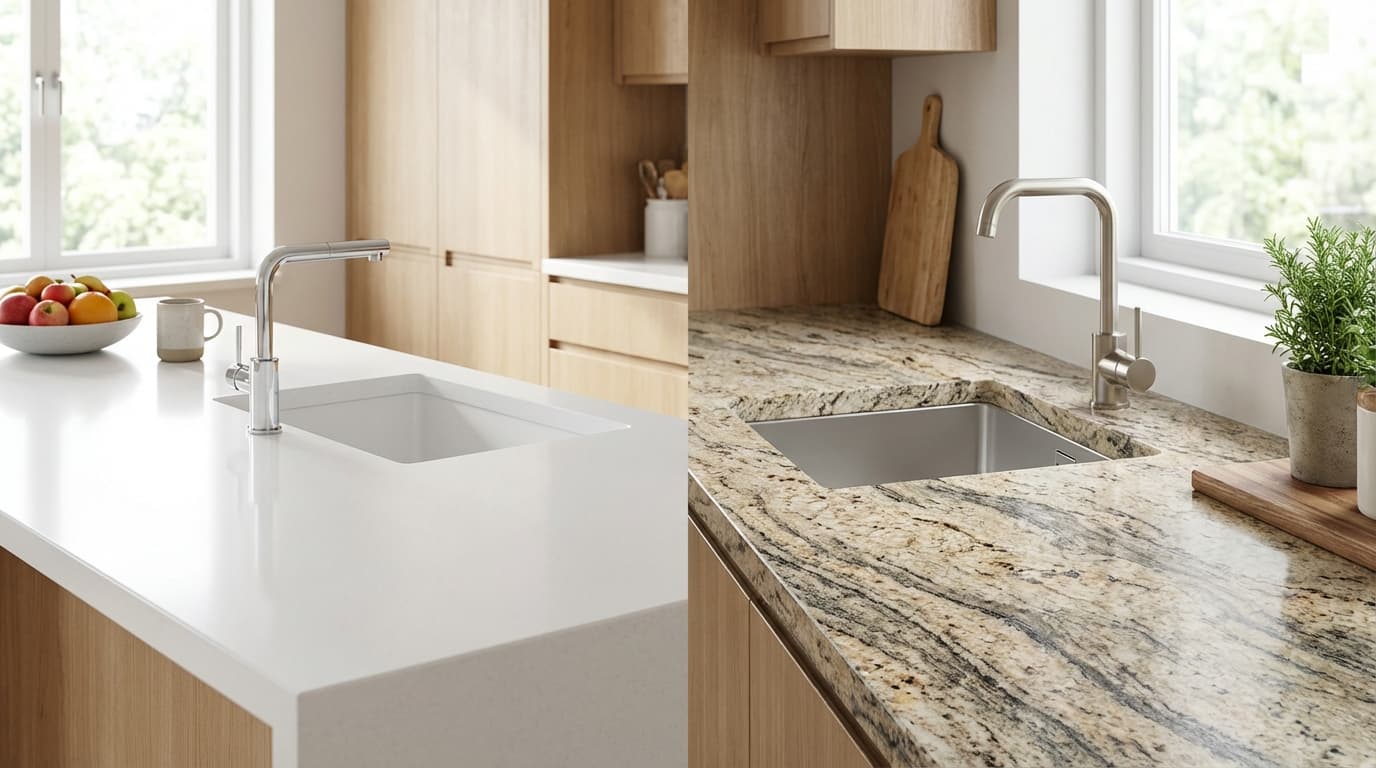
Few decisions in a kitchen remodel matter as much as your countertop. It's the surface you touch every day, the visual anchor of the room, and one of the biggest factors in how your kitchen feels and functions for the next couple of decades. For most homeowners along the Colorado Front Range, the choice comes down to two heavyweights: engineered quartz and natural granite. Both are excellent. They're just excellent in different ways.
At SEALA Kitchen & Bath, we install both every week for families from Castle Rock to Greeley, and the honest answer to "which is better" is always "better for what?" This guide walks through the real differences so you can match the material to how you actually live and cook.
The quick version
Quartz is an engineered stone, made from roughly 90 to 95 percent crushed natural quartz bound with resins and pigments. That manufacturing process gives it consistency, a non-porous surface, and zero sealing requirements. Granite is 100 percent natural stone, quarried in slabs, so every piece is one of a kind. It's extremely heat tolerant and prized for its organic veining, but it's porous and needs periodic sealing. Neither is a wrong answer. The right one depends on your priorities.
Durability: both are tough, in different directions
In a busy kitchen, durability is everything, and both materials hold up beautifully. Quartz lands at a consistent 7 on the Mohs hardness scale, making it highly resistant to scratches, chips, and stains. Because it's non-porous, liquids can't soak in, so it shrugs off wine, coffee, and oil without a second thought. Its one limitation is heat: the resins that bind it are safe to roughly 300°F, so a hot pan straight off the burner should never go directly on the surface. Trivets and hot pads solve this entirely.
Granite sits at 6 to 7 on the Mohs scale and is exceptionally heat resistant, easily handling temperatures well beyond what quartz can. If you're a serious cook who tends to set hot cookware down without thinking, that forgiveness is a genuine advantage. Granite is impact resistant too, though natural slabs can occasionally contain fissures that require care during fabrication and installation, which is exactly the kind of thing a good installer screens for.
- Quartz: consistent hardness, non-porous, excellent scratch and stain resistance, but keep hot pans off it
- Granite: outstanding heat tolerance and natural strength, ideal for heavy-duty cooking
Maintenance: how much upkeep do you actually want?
This is where many homeowners make their decision. Quartz is about as low-maintenance as a countertop gets. Because it's non-porous, it never needs sealing. Day-to-day care is simply mild soap and warm water, avoiding harsh chemicals and abrasive scrubbers that could dull the finish over time. For busy families, that set-it-and-forget-it simplicity is hard to beat.
Granite is porous, so it benefits from periodic sealing, typically every year or two, to keep spills from penetrating and to protect against staining. Once it's sealed, daily care is easy: wipe it down with a gentle cleaner and you're done. Resealing is a quick task, not a burden, but it is a task. If occasional upkeep in exchange for natural beauty sounds fair to you, granite earns its keep. If you'd rather never think about it, quartz wins.
Style: engineered consistency vs. natural character
Aesthetics often tip the scales. Quartz is engineered, which means uniform color and pattern across the whole slab and from slab to slab. It comes in an enormous range of looks, including convincing marble lookalikes, soft concrete tones, and bold colors you simply won't find in nature. That predictability makes it a favorite for modern, minimalist kitchens where seamless, matched surfaces are the goal.
Granite is the opposite philosophy: every slab is unique, with veining, movement, and mineral speckles formed over millions of years. No two kitchens with granite look quite the same, which is the whole appeal for homeowners chasing warmth, character, and a one-of-a-kind centerpiece. The trade-off is that because slabs vary, it's worth viewing your actual slab in person rather than choosing from a small sample.
What about value?
Talking about value without talking about your specific kitchen is mostly guesswork, because the right choice depends on your layout, edge profile, slab selection, and how you use the space. Rather than chase a number, focus on what genuinely adds long-term value: a material that fits how you cook, a finish you'll still love in fifteen years, and professional fabrication and installation that gets the seams, supports, and overhangs right. A countertop installed correctly outlasts and outperforms a pricier slab installed poorly, every time.
That "Affordable Quality" balance is exactly what we aim for at SEALA. The best way to understand what a given material means for your project is to get a free, no-pressure estimate where we look at your actual kitchen, not a generic chart. We also offer 12 months same as cash financing to make the right choice easier to act on.
Our take for Front Range kitchens
Choose quartz if you want low maintenance, a clean and consistent look, and a surface that forgives spills as long as you keep hot pans off it. Choose granite if you love natural, one-of-a-kind stone, you cook hard and want maximum heat resistance, and you don't mind sealing it now and then. Both are workhorses that will serve a Colorado kitchen beautifully for decades, and both are backed by our 5-Year Labor Warranty plus the lifetime manufacturer parts warranties.
See your options in person
The fastest way to fall in love with a countertop is to stand next to the real slab and watch the light move across it. If you're remodeling anywhere from Castle Rock to Greeley, we'd be glad to help you compare quartz and granite for your specific kitchen and answer every question along the way. Reach out for a free estimate and we'll help you choose a surface you'll enjoy for years to come.
Frequently asked
For most busy households, quartz is the easier choice because it's non-porous, never needs sealing, and resists stains with just soap and water. The one rule is to keep hot pans off it. Granite is a great pick if you cook hard and want maximum heat resistance, as long as you don't mind resealing it every year or two.
Yes. Granite is a natural, porous stone, so it benefits from sealing roughly every one to two years to protect against staining. It's a quick, simple task rather than a major chore, and once sealed, daily care is just a gentle wipe-down. Quartz, by contrast, never needs sealing because it's engineered to be non-porous.
Match the material to how you live. Pick quartz for low maintenance and a consistent, modern look, and granite for natural one-of-a-kind character and superior heat tolerance. The best next step is a free in-person estimate where we look at your actual kitchen and let you see real slabs, serving the Front Range from Castle Rock to Greeley.
Keep reading
Ready to start your remodel?
Free consultation and estimate · 12 months same as cash · 5-Year Labor Warranty.