Smart Kitchen Storage and Walk-In Pantry Ideas to Cut Clutter for Good
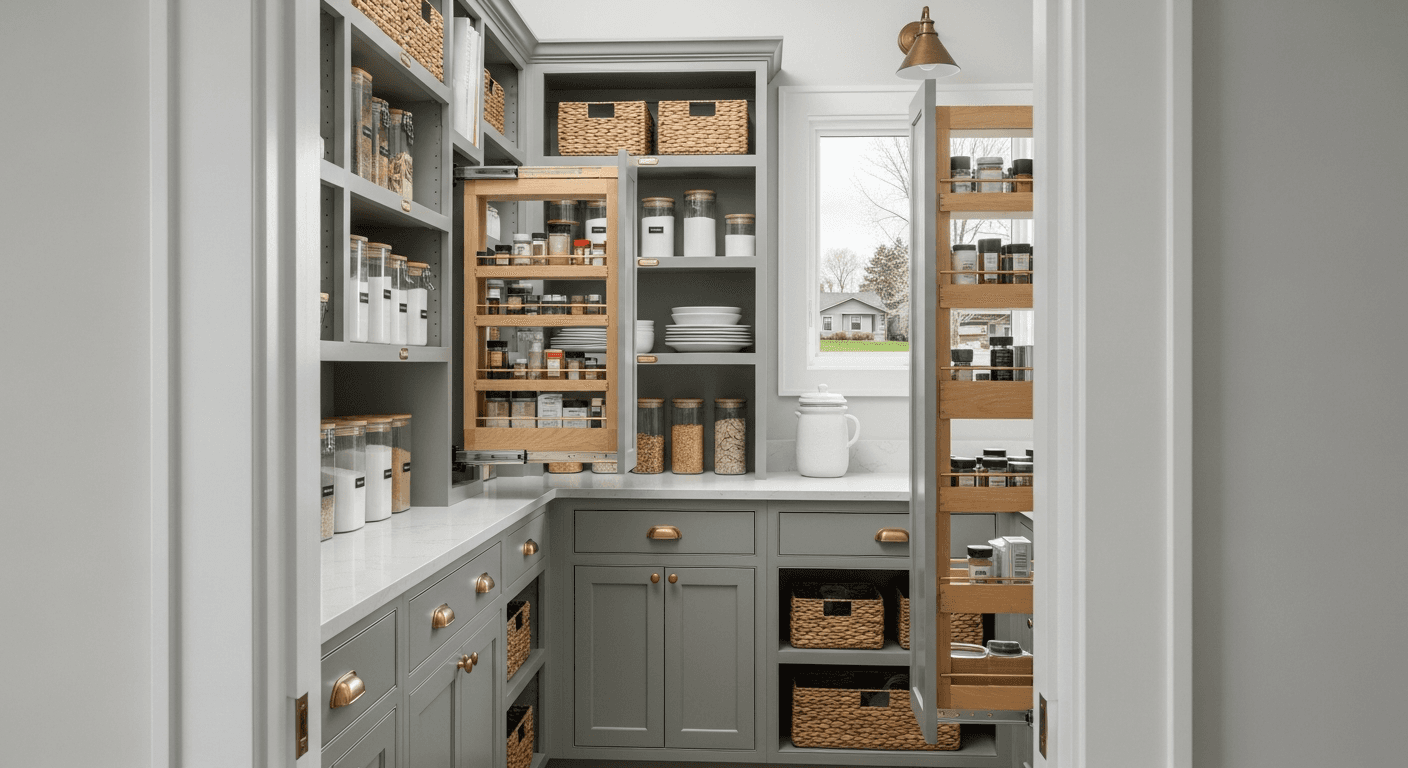
Short answer: the kitchens that stay clutter-free aren't the ones with the most storage—they're the ones where every item has an easy-to-reach home and a habit-proof way to get put back. The biggest wins come from swapping deep, dark base cabinets for full-extension pull-out drawers, organizing drawers with dividers so nothing piles up, solving awkward corners and the cabinet above the fridge, and—if you have the room—adding a walk-in pantry laid out in clear zones. Do those few things well and you reclaim counter space, find what you need in seconds, and stop the daily pile-up before it starts.
Most kitchen clutter isn't a quantity problem—it's an access problem. When the food processor lives behind three other appliances in a deep lower cabinet, it ends up on the counter for good. When spices are stacked two-deep in a wall cabinet, the duplicates multiply because nobody can see what they already own. Smart storage fixes the access, and clutter quietly takes care of itself. Here's how to think about it, room zone by room zone.
Start by fixing your base cabinets (this is where clutter hides)
Standard base cabinets are storage's weakest link: they're deep, they sit low, and everything in the back disappears into a black hole you have to kneel and dig through. The single most effective upgrade in any kitchen is converting those static shelves into pull-out solutions that bring the back of the cabinet to you.
- Full-extension pull-out drawers and roll-out trays: Instead of reaching into a cabinet, you pull the whole shelf out and see everything at once. Great for pots, pans, small appliances, and canned goods.
- Deep pot-and-pan drawers: Wide, sturdy drawers under the cooktop hold heavy cookware far better than a low shelf, and lids can stand upright in a divided section.
- Pull-out trash and recycling: Hiding two or three bins behind a cabinet door clears the floor and keeps the most-used 'station' in your kitchen out of sight.
- A pull-out pantry cabinet: A tall, narrow cabinet with shelves on both sides of a sliding frame turns an 8-to-12-inch gap into a surprisingly roomy dry-goods store where every item faces front.
If you do nothing else, pull-outs in your two or three busiest lower cabinets will change how the whole kitchen feels. They're the highest-impact storage change we install, and they work in almost any layout.
Make every drawer earn its space
Drawers are easier to use than cabinets because everything is visible the moment you open them—but an unorganized drawer just becomes a junk pile you can see. The fix is dividers and inserts that give each category a defined spot.
- Adjustable wood or composite dividers keep utensils, gadgets, and tools from sliding into one tangled mass.
- Deep drawer pegboards (a peg system inside a wide drawer) hold plates, bowls, and mixing gear upright so a single drawer replaces a whole stack of awkward cabinets.
- A dedicated knife block insert that lies flat in a drawer frees the counter and keeps blades safe.
- Tiered spice inserts angle jars so you read every label at a glance—no more buying your third jar of cumin.
- A charging drawer with a built-in outlet hides phones, tablets, and cords, which clears one of the most common counter-clutter culprits.
The principle behind all of it: when a thing has an obvious slot, it gets put back. When it doesn't, it gets set on the counter 'for now.' Dividers turn 'for now' into 'away.'
Conquer the awkward spots: corners, tall walls, and dead zones
Every kitchen has problem geometry. These are the spaces that swallow gadgets and never give them back—and each one has a purpose-built solution.
- Corner cabinets: A lazy Susan or, better, a kidney-shaped swing-out shelf (sometimes called a magic corner) pulls the contents of a blind corner fully into the open instead of leaving you fishing in the dark.
- The cabinet above the fridge: Reserve it for genuine long-term storage—holiday platters, the roasting pan, the waffle maker—and add a vertical tray divider so flat items file like books instead of toppling.
- Toe-kick drawers: The few inches under your base cabinets can become shallow drawers for baking sheets, linens, or pet bowls.
- Narrow fillers: That 6-inch gap beside the range or fridge can hold a pull-out tray rack for cutting boards and baking sheets, or a slim spice pull-out.
- Open vertical wall space: Wall-mounted rails for utensils or a magnetic knife strip move daily-use items off the counter without filling a drawer.
Walk-in pantry ideas that actually stay organized
A walk-in pantry is the dream for a reason—it takes bulk storage, small appliances, and overflow completely out of your main cabinets. But a walk-in only stays tidy if it's designed in zones rather than as a wall of identical deep shelves. The most common pantry mistake is shelves so deep that the back becomes a graveyard of forgotten cans.
- Keep most shelves shallow (roughly 12 to 16 inches) so nothing hides behind anything. Reserve one deeper run for bulk paper goods and large appliances.
- Zone by use, not just by category: an everyday-snacks zone at kid height, a baking zone with flour and sugar in clear canisters, a small-appliance zone with an outlet for charging or even using the blender right there, and a top shelf for things you touch a few times a year.
- Add pull-out baskets or bins for produce that shouldn't be refrigerated—onions, potatoes, garlic—so they breathe and stay visible.
- Use clear, labeled containers for dry goods. Seeing what you have (and what's running low) is what prevents both clutter and duplicate buying.
- Build in a counter or landing shelf if space allows—it becomes a drop zone for groceries and a home for the appliances you'd otherwise leave out in the kitchen.
- Light it. A motion-sensor light or a switched fixture means you can actually see the back corners, which is half the battle in any pantry.
No room for a true walk-in? A reach-in pantry closet or a tall pull-out pantry cabinet captures most of the benefit. The zoning logic is identical—shallow, visible, and assigned a purpose—just in a smaller footprint.
A few habits that keep it that way
Storage gives clutter a place to go, but a couple of simple habits keep it from creeping back. Store items where you first use them—coffee and mugs by the coffee maker, baking gear near the mixing counter—so putting things away is the path of least resistance. Keep the most-used 20 percent of your tools in the most-reachable 20 percent of your storage. And once a season, pull the duplicates and the never-used gadgets; clutter-free kitchens are edited kitchens as much as organized ones.
Designing storage into a Front Range remodel
If you're already planning a kitchen update, that's the ideal moment to build storage in rather than bolt it on later—pull-outs, drawer systems, corner solutions, and a pantry layout are far easier and cleaner to integrate during a remodel. SEALA Kitchen & Bath serves the Denver metro and Front Range from Castle Rock to Greeley, and we're glad to walk your kitchen with you, look at how you actually cook and shop, and map out a storage plan that fits your space and the way you live—that's what Affordable Quality means to us. Our work is backed by a 5-Year Labor Warranty plus lifetime manufacturer parts warranties, and financing is available with 12 months same as cash. Call (720) 663-5094 or email hello@seala.com to book your free estimate.
Frequently asked
Converting deep lower cabinets to full-extension pull-out drawers or roll-out trays. Standard base cabinets hide everything in the back, where it gets forgotten and clutter piles up on the counter instead. Pull-outs bring the entire contents into the open with one motion, so pots, small appliances, and pantry goods are all visible and reachable. It's the change that most dramatically improves how a kitchen feels day to day, and it works in almost any existing layout.
For most items, shallow shelves of roughly 12 to 16 inches work best, because anything deeper turns the back of the shelf into a spot where cans and boxes disappear and get forgotten. Keep the bulk of your shelving shallow and visible, and reserve just one deeper run for large appliances and bulk paper goods. Pairing shallow shelves with clear, labeled containers and zones by use is what keeps a pantry organized long after move-in day.
Often, yes. Many upgrades—pull-out trays, drawer dividers, corner swing-outs, and tall pull-out pantry cabinets—can be added to your existing cabinets. A full remodel is the best time to design storage in from the start, but it isn't always required. The right approach depends on your current cabinets and how you use the space, which is exactly the kind of thing we can assess during a free estimate and recommend honestly.
Keep reading
Ready to start your remodel?
Free consultation and estimate · 12 months same as cash · 5-Year Labor Warranty.